Monday, April 7, 2014

Uddamethi

Today I am posting a recipe from Goa. Everyday this week I will post a recipe from a different state in India.


Goa is very dear to me as I spent my childhood there. A quiet place where life moved at a very slow pace. A place where store owners downed their shutters at noon to take an afternoon break. A place where everything closed by 7 pm as people headed home to spent time with family.

The beaches were beautiful with very few people around. The sand was clean and invited everyone to build sand castles. The dog chased after the little crabs that ran all over the sand. The water was clean and lovely for anyone who wanted to swim. An evening stroll on the beach could mean watching the local fishermen cast a net in the shallows to bring in a catch. The day ended with a glorious sunset that turned the sky a brilliant red. This picture of a fisherman's boat beached at Bogmalo Beach was taken in the 70s.


Lots of kids took a boat ride across a river or river estuary to get to school/collage. The picture below overlooking the harbor shows the Zuari river estuary. We took a boat across to Dona Paula to get to college. If you were lucky you would see dolphins swimming alongside the boat.


Everywhere you looked everything was green. When I moved to Arizona I truly appreciated the greenery we so took for granted. The tall evergreen trees, cashews, mangoes, jackfruit and banyan. The picture below is the famous deepmal at Mangeshi temple. It is lighted up to the very top during the holidays and looks lovely in the night sky.


Goa is very different today. It has grown very fast and has a lot more people than there used to be when I lived there. The days when everyone in town knew everyone else are long gone but the people are just as easy going and helpful as they were. That has not changed at all.

Authentic Goan recipes in Hindu homes are very different from the non-Hindu homes. The Hindu recipes have little or no influence of the Portuguese culture. It is admirable how these families in defiance of the Goan inquisition practiced and preserved their culture and cuisine.

The recipe I picked for Goa is Uddamethi. This recipe comes from the Hindu households in Goa and is finger licking good. Uddamethi, the name refers to the urad dal and methi seeds used. But the jaggery and the raw mango all add to the flavor.


I got this recipe from a family friend, a Goan and a very good cook. She also cooks awesome human (who-mann) or fish curry.

You will need
1 raw mango
3 tbsp. jaggery
1 tsp. mustard seeds
4 curry leaves
1 tsp. fenugreek seeds
1/4 tsp. asafoetida
4 tbsp. olive oil
salt to taste

Masala
1 tsp. fenugreek seeds
1 tsp. urad dal
1 tsp. coriander seeds
2 dried red chili pepper
1/4 cup desiccated coconut
1/2 tsp. turmeric powder

Wash and peel the mango. Slice off the sides as close to the pit as you can. Save the pit with the pulp around it to make panha. Chop the slices into cubes. Keep aside.

Heat 2 tbsp. oil in a pan and roast the first four masala ingredients, fenugreek seeds, urad dal, coriander seeds and red chili pepper. Drain away the oil and along with the coconut and turmeric powder grind to a paste. Keep aside.

Add the remaining oil to the pan. Heat the oil and add mustard seeds. When they crackle add the crackle add the curry leaves, fenugreek seeds and asafoetida.
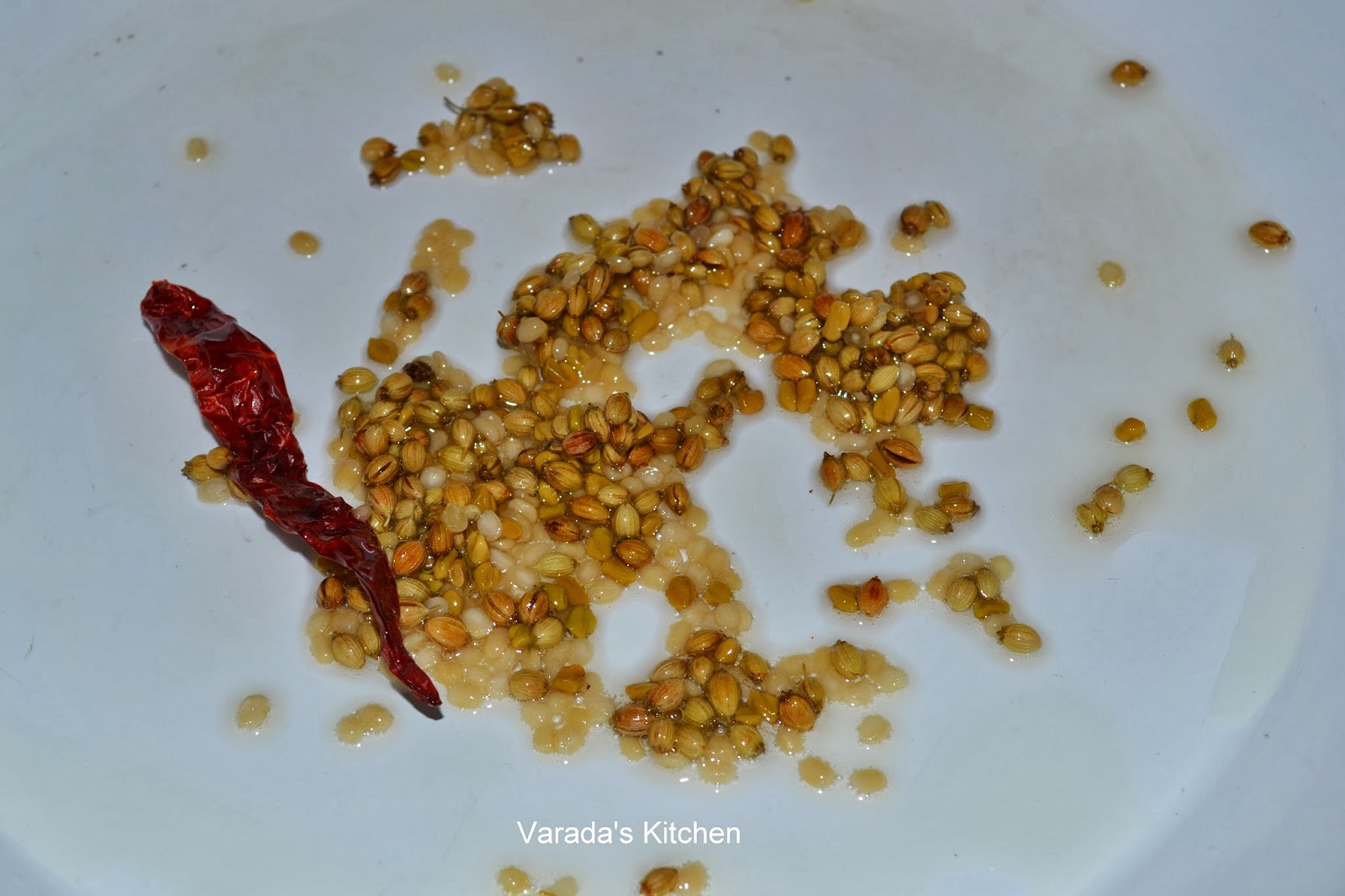

Now add the mango, jaggery and salt. Mix together.


Add enough water to just cover the mango cubes. Cook on high until the mango is tender but not mushy. There will be a distinct change in the color of the mango and most of the water should have evaporated.


Add the masala paste and mix together. Bring to a boil and simmer on low high for a couple of minutes.


Turn off the heat and serve with rice.

Sunday, April 6, 2014

Mango Lassi

Today I am posting a recipe from Delhi, the national capital of India. Everyday this month I will post a recipe from a different state in India.


Delhi is one of the largest cities in the world. It is not one of the oldest cities but has been in existence for a few hundred years. For most of those years Delhi has enjoyed a status of prominence as a capital. A few years back Delhi was awarded statehood.

On our last trip to Delhi we were walking through the neighborhood market when we noticed these people on the sidewalk with mehendi cones. Apparently it was a local festival the day after and they were offering to paint one of the oldest art forms known to us - mehendi (henna). It is amazing how intricate designs are painted in under 5 minutes. The picture shows my daughter getting her hand painted and the final result.


Before I move on to the recipe for the day I have to go back to my visit to Delhi on our first trip back to India. My husband took me to a few of his favorite college day eateries. One of them was a burger joint near his IIT campus. Another was chaat in Karol Bagh. We ordered chat and then he ordered lassi. Now I was not a lassi kind of girl. Give me a shake any day but I did not care for lassi. The place was very crowded and everything had to be ordered so quickly, before I could say anything he had placed the order. It didn't help that a couple came and stood by our table to lay their claim to it.

So now there was a tall glass of white fluffy liquid on the table and a very excited husband watching me from across the table. I reluctantly picked up the glass of lassi and started sipping it. I never knew when I hit bottom. It was so good! Since then I never shy away from lassi, especially not in Delhi. And when it was time to look up a recipe for Delhi I could not think of anything better than lassi. Since it is mango season I decided to make mango lassi.

You will need
1/2 cup yogurt
1/4 cup mango pulp
1/4 cup milk

Mix all the ingredients together and blend for a minute or two.


You could add ice while blending if you like it really cold or if you are having it in summer.


Serve chilled.

Saturday, April 5, 2014

Lal Masar Kadhi (Red Lentil Kadhi)

Today I am posting a recipe from Chattisgarh. Everyday this month I will post a recipe from a different state in India.


Chattisgarh is a new state in India. When I lived in India it used to be a part of Madhya Pradesh. The counties speaking the Chattisgadi dialect were carved out of Madhya Pradesh in 2000 to form the state of Chattisgarh. The name Chattisgarh literally means 36 forts. But as the 36 forts have not been identified the origin of the name is disputed. There are a lot of theories about the name but no one theory that everyone can agree upon. What is beyond dispute is that the region has been known as Chattisgarh forever and now it is its own state.

A quarter of the population of Chattisgarh is tribal and one of the largest tribes is called the Gond. This tribe has inhabited the region for thousands of years. You will find the Gond tribe in neighboring states of Maharashtra, Madhya Pradesh, Uttar Pradesh and Andra Pradesh. In Chattisgarh they inhabit the dense forests of the Bastar region.

Art and music is a part of tribal life and the Gond are no different. They specialize in a form of dot art and decorate their walls and floors with it. The pictures mainly depict the forest, trees, animals and birds. The paintings could be colorful or black and white. Limestone and charcoal is the painting medium used for Gond art. This picture is a sample of the style. I made it for a folk art class I taught.


The most interesting part of this art form is that the dot art by the aboriginal Australians is very similar to the Gond art. Is there a connection? Did the same ancient group of people migrate to two different places or did they trade among themselves? I know as food bloggers we ask the same question when we find recipes that are similar in two countries separated by vast oceans, especially when both countries consider it part of their tradition.

Back to the recipe: the recipe for lal masar kadhi or kadhi made with red lentils was given to me by a friend. It is now a family favorite on cold or rainy days. While most homes in most parts of India have some form of lentils on their daily lunch and dinner plate, it is the yogurt used in this preparation that I find interesting. The resultant kadhi is very flavorful.

You will need
1 cup red lentils (masoor dal)
1 tbsp. olive oil
1 tsp. mustard seeds
4-5 curry leaves
1 whole dried red chili pepper
1/4 onion, chopped
1 tsp. turmeric powder
1/4 tsp. asafoetida
1 Serrano pepper, deseeded and minced
1/2 cup yogurt
2 tbsp. besan (chickpea flour)
1/4 cup cilantro, chopped
salt to taste

Soak the lentils for an hour.


Pressure cook the soaked lentils.


Heat oil in a pan and add the mustard seeds. When they crackle add the curry leaves, dried red pepper and onion. Saute for a few minutes and add the turmeric powder and asafoetida. When the onion is cooked add the minced serrrano peppers, lentils and mix well.


In a separate bowl whisk the besan with the yogurt leaving no lumps. Thin the yogurt with water if needed. It should be the same consistency as buttermilk. Pour the yogurt into the pan with the lentils.


Season with salt. Bring to a boil. Lower heat and simmer for about 10 minutes. 


Garnish with cilantro. Serve hot with poli or rice.

Friday, April 4, 2014

Makhana Kheer

Today I am posting a recipe from Bihar. Everyday this month I will post a recipe from a different state in India.


Bihar is located in the north of India sandwiched between Uttar Pradesh and West Bengal. Bihar from my memory was a coal rich area. Most of the coal reserves are now in Jharkhand, the state that was carved out of Bihar.

Bihar is also known for an original art style called Madhubani. The origin of Madhubani paintings is not known. Women in the Madhubani region, near Mithila, in northern Bihar have been painting on freshly plastered mud walls and floors of their homes for centuries. The art is passed on from mother to daughter. This art style has seen a major revival in recent years. Today these paintings can be found on cloth, handmade paper and canvas too. The picture below is a sample from a children's folk art class I once taught. This piece was done by one of my students.


When I think of Bihar and food I think of Lithi. Accordingly I made lithi and we all enjoyed it very much. But then I thought I should try something different. A friend suggested makhana kheer. Phool Makhana or fox nut comes from the lotus plant. Makhana is commonly used in Bihar, Jharkhand and Madhya Pradesh. The Darbhanga region of Bihar is where makhana kheer originated. This region is also the largest producer of Makhana.


I had never heard of makhana until I got married. It was something I first tasted as a new bride. My husband's family is from Madhya Pradesh and makhana is very popular there. My mother-in-law is from Maharashtra and knew I would have no idea what makhana was. Everybody was making a big deal about it and I have to say when I got my first taste of a roasted makhana it was a big let down. It is pretty bland compared to all the seeds and nuts we normally eat. But this kheer is anything but bland. It has a lovely flavor even if you use low fat milk especially if you thicken it with ground roasted makhana.

I had seen makhana at the local Indian store and realized I would have to buy the big bag of makhana. I needed less than half the bag for the kheer but I bought it anyways. My husband roasted and finished the rest.

You will need
2 cups makhana
5 cups milk (I used 1% milk)
1/4 cup sugar
a few each of almonds, cashews and pistachios
a few raisins
2 pods cardamom
2-3 strings saffron

I used 1% milk. You can use any fat content that you have on hand. Bring the milk to a boil in a pan stirring frequently to prevent cream from forming.

Meanwhile, roast the almonds, cashews and pistachios on a baking sheet in a 350 F oven. Chop the roasted nuts lengthwise and keep aside. Shell the cardamom pods and pound the seeds to a powder with a mortar and pestle. Clean the makhana and roast them in the same pan. The makhana get crunchy when roasted.


Take off heat and let them cool. Grind half the makhana to a coarse powder.


Continue to heat the milk for about 5-10 more minutes on medium heat. Add the sugar, whole makhana as well as the powder to the milk. Mix well. The milk will thicken. Ensure there are no lumps. Add the chopped nuts, raisins, saffron and cardamom powder to the milk. Heat for another 5 minutes and turn off heat. You can serve the kheer warm or chilled.


Enjoy!

Thursday, April 3, 2014

Bootor Dali (Chana Dal, Bengal Gram Dal)

Today I am posting a recipe from Assam. Everyday this month I will post a recipe from a different state in India.


The recipe I chose for this state is called bootor dali which literally means chana dal. I found it on the blog written by Sunita Bhuyan. Sunita is from Assam and though she has not blogged for a while her blog is very interesting. Do visit her and look around.


This is an everyday recipe in Assamese households. It is a simple but tasty dal preparation that brings out the flavor of channa dal. A little Masoor dal is added to this dish as it cooks quicker than the chana dal and helps thicken it.

Channa dal is one of the more flavorful dals so I expected this dish to be tasty. I add channa dal to my every day dal when I feel like I want a change. But since I do not use onions, ginger or garlic in my every day cooking I never cook dal this way. This dish was so flavorful it took us completely by surprise. I will be making this again.

I made this dal almost dry without gravy so I could serve it as a side dish. You may keep more liquid if you wish.

You will need
1 cup chana dal
1/4 cup masoor dal
1/2 onion, minced
1 Serrano pepper, deseeded and minced
1 tsp. cumin powder
1 tsp. ginger garlic paste
1 tsp. turmeric powder
1 tsp. jaggery or sugar
1 tsp. cumin seeds
1 bay leaf
1 tbsp. olive oil
a bunch cilantro, chopped, divided
salt to taste

Wash the chana dal and masoor dal, drain the water and keep aside.


Heat oil in a pan and add the cumin seeds and bay leaf to it. When the seeds change color add the onion, ginger garlic paste, pepper and turmeric powder to it. Saute until the onion is cooked. Add a little water if needed.


Add jaggery or sugar and mix well. Add the chana and masoor dal to the pan. Cook the dals for a few minutes until the mixture comes together. It should take no more than 7-10 minutes.


Add enough water to completely cover the dals and then a quarter cup more. Bring it to a boil. Transfer the contents to a pressure cooker. In my pressure cooker I place the weight when the steam starts to escape and leave it on high heat for 10 minutes. Turn off the heat and let the pressure drop. This is equivalent to three whistles. Transfer the contents back to the pan.


If the dal is too dry then add a little water. Bring it to a boil on medium heat. Season with salt and add most of the cilantro. Let it simmer for another 2-3 minutes. Turn off the heat, garnish with remaining cilantro and serve hot with poli or parathas.


Wednesday, April 2, 2014

Chocolate Truffles

Three layers of chocolate make up these delectable truffles. The core is made of dark chocolate ganache covered with melted dark chocolate and rolled in dark chocolate shavings.


The theme this week for the 2014 52 week challenge is Belgian. For some reason I could not look past chocolate. I had to make these truffles.

You will need
For the ganache
4 oz. dark chocolate (I used 60%)
2 oz. heavy whipping cream
1 oz. unsalted butter

For the covering
2 oz. dark chocolate
1/4 cup dark chocolate shavings

To make the ganache cut the chocolate into small pieces and place in a mixing bowl.


In a separate pan heat the heavy whipping cream. Mix in the butter and heat until very hot but not boiling.


Pour the cream mixture over the chocolate pieces and whisk together. Ensure all the chocolate has melted. Cover and refrigerate for 2-4 hours.


To put it all together shred the chocolate over a grater and spread the chocolate shavings in a plate.


In a double boiler melt the dark chocolate.

Cover a sheet with parchment paper and keep it aside. You will need a toothpick or something similar to fish out the ganache balls from the melted chocolate. Take the ganache out of the refrigerator. It will have thickened considerably.


Take a 1 - 1 1/2 tbsp. of ganache and form into a ball. Roll it in the melted chocolate. With the help of a toothpick take it out of the chocolate bath and roll it in the chocolate shaving. Place on the parchment paper. Repeat until you use up all the ganache.


Chill for a couple hours before serving.

I am submitting chocolate truffles as my entry for the 2014 52 week challenge for the theme Belgian.

Momo Dumpling

Today I am posting a recipe from Arunachal Pradesh. Everyday this month I will post a recipe from a different state in India.


Arunachal Pradesh is one of the northeastern states of India and part of it borders China. It is a naturally beautiful state located mostly in the Himalayas.

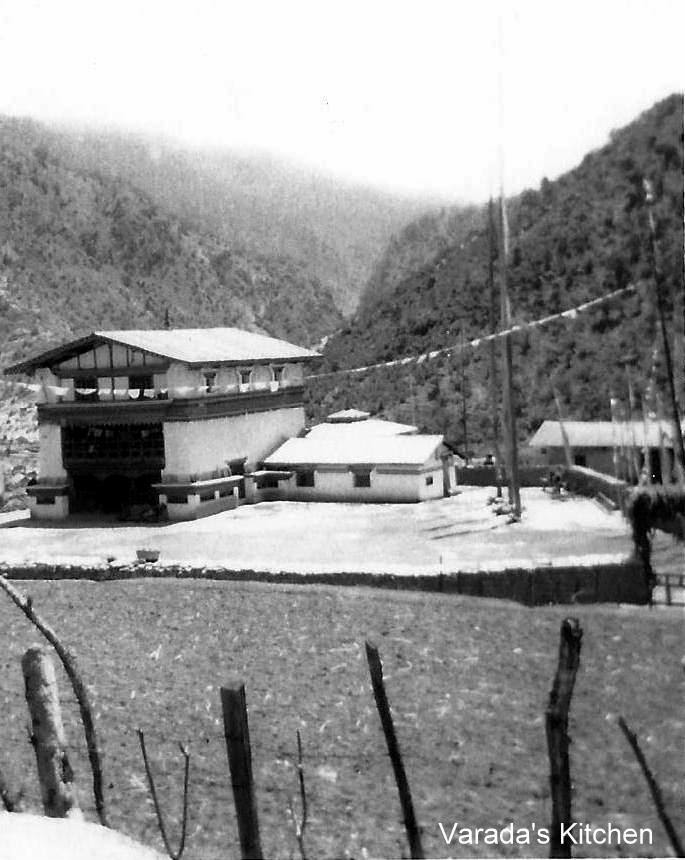
While I was looking up information on this state I found this travelogue in Mid Day. One sentence caught my attention. "On a particular trip to Arunachal Pradesh, in the small town of Bomdila" the author had momos. Bomdila: a small town in a valley close to the Chinese border. I have been there as a child of 8 or 9 years. It was a very long and tiring bus ride to get to the town. Today a special permit is needed to visit the area. Back then there were no restrictions to visit Arunachal Pradesh. The B&W pictures below are from that trip.


I vaguely remember the endless streams, the shaky bridges over them and lots of flags. We were in a very rural area visiting my uncle who was in the Army. We were there for about a week. Everywhere you looked you saw mountains. Growing up in Goa, hilly terrain was not new to me. But this was different, the elevation was much higher than sea level. And the air was crisp and clean.


We went for long walks to take in the countryside. I remember a walk in the mountains and everyone getting tired and thirsty. That is when someone local pointed to a stream of water coming straight out of the mountain. True mountain spring water, refreshing, fresh and most importantly, not bottled.

After revisiting the fond memories of that trip I decided I wanted to make momos. Momos can be found in all the northeastern states of India. They are believed to have been brought to the region by traders from Tibet. I got this recipe from a bunch of different places so I cannot credit any one site here. The momos were delicious.

You will need
For the shell
1/2 cup rice flour
salt to taste
1 tsp. olive oil

For the filling
1/2 cup cabbage, shredded
1/4 cup onion, diced
1 tbsp. olive oil
salt to taste

To make the filling
Heat oil in a pan. Add the onion and cabbage to it. Cook until tender. Add salt to taste and let it cook another minute before turning off the heat. Keep aside.


To make the dough for the shell
In a mixing bowl mix rice flour and salt with a little water. Knead into a soft ball. Using the olive oil to coat your fingers knead again and keep aside for 15-20 minutes.

To put it together
Put water in the steamer and bring it to a boil. Grease the steamer tray with olive oil.
Divide the dough into five small portions. On a working surface, using rice flour roll out one of the portions into a disc.


Place the disc in the palm of your hand and work one side of the disc into folds.


Place a teaspoon of filling inside.


Seal the top to form a lopsided empanada.


Place it on a greased streamer tray. Repeat with the other portions of dough.


Steam for about 10 minutes on medium high heat. Turn off heat and let the momos rest for a few minutes. Take them out of the steamer and serve.


I served them with ketchup and they were delicious.