Showing posts with label Indian Snacks. Show all posts

Friday, May 11, 2018

Chole Chaat

I cook with Garbanzo beans very often. I use it in all kinds of sides and salads as it has a high protein content. But my husband and I like it best in salads. Today I am posting a recipe for Chole Chaat. Mix the cooked garbanzo beans with a little onion, tomato and basic spices and you have a tangy delicious protein rich snack.


Two months back I was in the mood for chaat. I made several recipes over a couple of weeks and will post them one by one. We don't like food too spicy and I use chili peppers sparingly. If you like the chaat mild then this is the recipe for you.

You will neede
1 cup dry garbanzo beans
1/2 onion
1 tomato
1 tsp shredded ginger
1 tsp chaat masala
1 tsp cumin powder
1/2 tsp turmeric powder
salt and pepper to taste

Soak the beans overnight. The next day pressure cook the beans until cooked. I let the pressure built up in the cooker, place the whistle and let it cook for 10 minutes on medium high heat. Then turn off the heat and let it cool and release the pressure. Let the beans cool.


Meanwhile dice the onion and tomato. Mix all the ingredients together in a bowl.


Enjoy!

Thursday, October 5, 2017

Dal Vada in Appe pan (Not Deep Fried)

I have made a lot of different vada in the appe pan, dahi vada, batata vada, sabudana vada, methi vada etc. This is my latest experiment. I used the dals I had on hand in the proportion that felt good at the time. Mung dal makes the vada lighter and easier to cook, channa dal and lentils add a lot of flavor.


I made these as a evening snack but you may want to add them as a side to a dinner menu. They would also make great appetizers at a party.

You will need for 15-20 vadas
1/2 cup toor dal
1/2 cup red lentils
1/2 cup urad dal (split black lentils)
1/4 cup channa dal (split chickpea)
1/4 cup mung dal
1 1/2 tsp roasted cumin coriander powder
1 tsp turmeric powder
1 tsp paprika
1 tsp fennel seeds
Salt and black pepper to taste
Oil

Add all the dals to a bowl. Add enough water to the bowl to cover the dals and aside for about 2-3 hours. Drain the water. Blend the dals to a paste using a little water such that it has the consistency in the bowl in the picture below.


Mix in all the remaining ingredients except the oil.


Heat the appe pan on the stove top over medium heat. Add a drop of oil in each of the wells. Next using a tablespoon add the heaping spoonful of the mixture to each of the well. Cover and let it cook for 2-3 minutes on medium-low heat.


Check if the under side is done using a knitting needle or a skewer. If brown flip the vada.


Flip the remaining vada, cover and let it cook until done.


Dal vada is ready. East on its own as a snack or part of a meal.


Enjoy!

Sunday, June 5, 2016

Farali Vada

Fasting foods is a whole different category of foods. They are mostly starchy foods designed to keep you from starving while you focused on all things spiritual. Those who fast follow strict rules of what foods are permitted and what foods are not. Give a foodie a list of ingredients and she will come up with recipes. The fasting food choices have exploded over the centuries and there are cookbooks devoted entirely to fasting food recipes. The days of a simple quick preparation paired with some fruit are long gone. This recipe is one such preparation.


Pardon the quality of the pictures. I made these for a summer weekend snack and had to click pictures while everyone waited patiently. I had to tweak this recipe a couple times before I got the taste just right. You could make this recipe when fasting or like me (someone who does not fast) make it anytime. It makes a lovely afternoon snack.

You will need (10 vada)
3 large potatoes
1 tsp. roasted cumin coriander powder
a bunch cilantro, should be 1/4 cup when diced
1 Serrano pepper or other green chili pepper, minced
2 tbsp. roasted ground peanuts
1/4 cup shredded coconut
15-20 raisins
1 tsp. lemon juice
1 tsp sugar
salt to taste
a couple of tbsp. oil

Boil in the potatoes in a pressure cooker or on the stove top. To cook them in the pressure cooker place the potatoes in half an inch of water and place then in the cooker. When the pressure rises place the whistle and let it cook for 5 minutes. Turn off heat and allow the pressure to reduce. The potatoes are ready.

Mash the potatoes and combine with salt and the cumin coriander powder. Divide into 10 portions and leave aside until needed. In a separate bowl combine all the other ingredients. Season with salt, adjust to taste. Divide into 10 portions.

Flatten a portion of potato in the palm of your hand. Place one portion of the filling in it.


Bring up the outer edges of the potato together and form a ball around the filling.


Repeat for the remaining portions.


Heat an appe pan or an aebleskiver pan. Drop a a few drops of oil in each well. Place one prepared vada in each of the wells. Let it cook on medium heat. When the bottom is brown turn it over in the well using a skewer or a knitting needle. Continue to cook and turn until all sides are cooked through. If needed add a couple more drops of oil when you turn it over. Take it off the heat.


Enjoy as an evening snack or if you are fasting as a main meal!

Wednesday, March 18, 2015

Jowar Chivda / Sorghum Chivda / Jondhalyachya Lahya Chivda

Chivda is savory snack made with a variety of grains or with fried batter. My favorite has always been the churmure chivda (or puffed rice chivda). During Diwali I make the pohe chivda. Both are very easy to make and are great as a snack. This week my father is visiting and so I decided to make churmure chivda for him. I went with him to the Indian store to bring back supplies when he asked if jondhalyacha lahya or puffed sorghum was available. He said the chivda made with sorghum tastes really good and is very healthy too. I checked the store and luckily they had packets of puffed sorghum so that is what I went with.


This recipe is very similar to the churmure chivda. I used a whole 7 oz. packet of puffed sorghum as chivda is very popular in my house.

You will need
1 7 oz. packet of jondhalyacha lahya or puffed sorghum
3 tbsp. oil
3/4 cup roasted peanuts
a handful of curry leaves
1/2 cup cashews
3/4 cup raisins
3/4 cup daala (roasted yellow gram)
2 tsp. turmeric powder
2 tsp. cayenne pepper powder (adjust to taste)
1 tsp. sugar
salt to taste (~ 1 1/2 tsp.)

Place the puffed sorghum in a wide mouthed pan and roast until hot and crispy.


Keep aside. In the same pan heat the oil and add the peanuts. Saute until they begin to change color. Next add the curry leaves. Watch out they will splatter oil. Then add the cashews and raisins. Saute them for a few minutes. Next add the daala or yellow gram, turmeric powder, cayenne pepper powder and sugar. Add salt to taste judging the amount based on the sorghum to be added.


Combine everything and finally add the puffed and roasted sorghum. Combine everything and turn off the heat. Let the chivda cool completely before storing.


Enjoy!

Thursday, March 5, 2015

Methi Vade in Appe Pan

I had some left over methi leaves after I used most of the bunch to make something else. I wanted to made methiche vade in the appe pan. It was a great day to make them. There was fresh snow on the ground and the sun had come out. Everyone was happy to see the sun after so many gloomy days. The cats would not budge from near the window. As the snow began to melt there was hope that we would be able to get out of the house. At the time same we knew the temperature was only in the upper 30s. And something like vade are perfect for a cold wet day.


I do not deep fry anything in my kitchen. If I have to eat something that is usually deep fried I find an alternative. I either bake it or cook it in my trusty appe pan.

You will need ( for about 10)
1/2 cup coarsely chopped methi leaves
1 cup besan
1 tsp. cayenne pepper powder
1 tsp. turmeric powder
1/2 tsp. sugar
salt to taste
oil as needed

Mix all the ingredients in a bowl.


Add water to make a thick batter. It should be pouring consistency. When the vada are deep fried the batter is made thicker. But in the appe pan it is easier to use thinner consistency batter to allow it to cook completely. Heat the appe pan over medium heat. Add a few drops of oil in the bottom of each well. Pour the batter in the well until about 3/4 full. Let the bottom set. Then using a knitting needle or a skewer turn the vada half way. The batter will pour out.


Let it set a little and then turn the vada all the way such that the done side is on the top. Let it cook on low medium heat until completely cooked through turning frequently.


Enjoy the vada while they are hot.

Thursday, December 4, 2014

Baked Samosa

Samosas are a popular Indian snack and one of the well known items on menu cards in restaurants that serve Indian food. The spicy, tangy filling in the samosa is what makes the dish. However, it is traditionally deep fried. If you have ever visited my blog before you would know I don't deep fry anything. But we all love samosas in my house and so I make baked samosas. They taste just as heavenly with all the usual fix-ins.


This recipe is a Maharastrian recipe with no onion or garlic. I add chole masala to add a new flavor to the spice mix. The mix of spices are chosen to add a tangy, hot and sweet taste to the samosas. The chutneys highlight these tastes.


For the shell I used whole wheat flour, all purpose flour and semolina (rava) in a 1:1:1 ratio. For my Indian readers, if you do not have access to all purpose flour please do not use maida. Instead use regular chapati flour.

You will need
For the filling
1 large russet potato
1 cup peas (I used frozen)
1 large carrot
1 tbsp. olive oil
1 tsp. cumin seeds
1 tsp. turmeric powder
1 green chili pepper, minced (or more according to taste)
1 tsp. amchur powder (mango peel powder)
1 tsp. chole masala
1 tsp. cumin coriander powder
1 inch piece ginger, peeled and minced

For the shell
1 cup whole wheat flour
1 cup all purpose flour (you can use whole wheat flour)
1 cup semolina (rava)
3 tbsp. olive oil (or vegetable oil)
1 tsp. salt
3/4 cup water (adjust as needed)

To make the filling
Boil the russet potato in the microwave or pressure cooker. Peel and dice. Wash, peel the carrots and dice. In a microwave safe dish cook the diced carrot and peas until tender but not mushy.

Heat oil in a pan and add the cumin seeds. When they sizzle lower the heat and add the turmeric powder, green chili pepper, amchur powder, chole masala, cumin coriander powder and minced ginger. Saute for a few seconds. Now add the potatoes, carrots and peas. Mix the spices well with the vegetables and allow to cook until the vegetables are tender and everything comes together. Keep aside to cool.


To make the shell
In a mixing bowl combine the flours, semolina and salt. Heat the oil in a small pan and add it to the flour. Mix well together. Add the water and mix together. Use more water if needed. Form a soft dough and knead well for a couple of minutes. Cover and keep aside for 30 minutes.


To make the samosa
Preheat oven to 400 F. Knead the rested dough and break off a small portion the size of a lime. Keep the rest covered. Knead the portion of dough in your palm and place it on a work surface. Roll it into a 6 in disc. Using a knife or a dough cutter cut it into two equal halves.


Pick up one half and form a cone.


Fill the cup with the filling.


Moisten your finger with water and run it over the edge of the cone. Seal the edges.


Place the finished samosa on a baking sheet covered with parchment paper. Continue making samosas until the baking sheet is full. Warm a few tablespoons of milk in a bowl. Wash over the surface of the samosas. Bake them for 20-25 minutes or until the tops are beginning to change color.


Enjoy with tamarind chutney and mint chutney.

Saturday, October 25, 2014

Vada Pav

Vada Pav is a street food from Mumbai. Until I started working in Mumbai I had never tasted it or even heard of it. I was very wary of getting sick when I first started working in Mumbai so I stayed away from the street foods. Later a friend introduced me to it. She and I roomed together. She was from Nasik and had visited Mumbai many more times than I had. She insisted I try the vada pav from a street vendor. I was very skeptical. It was one thing to try grilled corn on the cob. The hot coals killed all the germs. But bread and vada were a different animal. After a lot of coaxing I tried it and really liked it. That version of vada pav was too spicy for me and I had to wash it down with lots of water. But the combination was great. And I did not get sick.


I am told there are wada pav chains in Mumbai now. I did not venture out to try it the last time I was in Mumbai but that may be because I was in a hotel close to the airport and the Mumbai office in Andheri, far away from these outlets.

After all these years the taste stayed with me and when I was wondering how to use these laadi pav I had baked I kept going back to vada pav. Finally I made vada pav at home. I made the garlic coconut chutney but deliberately kept it is very mild. You can spice it up with dry red chili peppers if you want. I had posted the recipe for batata vada a few days ago. I posted whole wheat laadi pav yeasterday. Today I bring it all together to present the wada pav.


It was only when I edited the pictures that I realized I had not put any green chutney on the bun I used for the pictures.

You will need
Laadi pav or Dinner roll
Batata vada
Green chutney

For the garlic coconut chutney
1 cup dry coconut flakes or powder
1 tsp. tamarind pulp
2 cloves garlic, minced
1 tbsp sesame seeds
1-2 red chili peppers (depends upon how brave you are, I am a wimp I skipped this)
1 tsp. red chili pepper powder (optional, use if not using red chili peppers)
3 tbsp. peanuts
salt to taste

Heat a small saute pan and add the dry coconut to it. Mix in the tamarind pulp such that it is distributed evenly. Continue to roast the coconut on low medium heat mixing it up occasionally so it does not burn. Remove from pan when done and add the minced garlic to the same pan. When roasted remove from pan and add the sesame seeds. Next add the red chili pepper. Let all the roasted ingredients cool before adding them to a grinder along with the peanuts and salt. Grind to a powder.

If you used red chili peppers your chutney will turn an orange red. Since I used red chili pepper powder mine was a dull orange.

To put it all together
Cut the pav though the center. Add the garlic chutney to one side and apply the green chutney to the other. Place the vada over the garlic chutney and place the other half of the pav over the top.


Enjoy!

Saturday, October 18, 2014

Batata Vada in Appe Pan (Not deep Fried)

I am in love! With my appe pan. This simple pan has changed the way tea time snacks are prepared in my house. My first experiment dahi vada was very successful. No one could tell the difference. That gave me a lot of confidence to experiment with other deep fried snacks. I tried dal vada, paneer kofta and a variety of other foods that I did not photograph or blog about. Over time I have gotten better at using the pan which is not surprising since I use it so often. I have better judgment of the size and shape of the food I cook in it. I am also better able to end up with perfect rounds instead of flat discs. By the time I made sabudana vada I knew I could make anything in this pan. Batata vada is my newest experiment.


The best part about using this pan is that I use a fraction of the oil that would otherwise be needed. Oil is mainly fat and fat is good for you in moderation, in fact fat is needed. However, the main problem with deep frying foods is not the oil itself but the effect it has on the nutrients in the food being fried. Science is all over the place on this one so I decided to stop deep frying foods and instead get the fat from other sources. While baking is a natural alternative some recipes do not do well when baked. And so I am in love with this pan. It allows me to enjoy a whole variety of snacks that I stopped making when I stopped deep frying foods.

Batata vada was one such snack. I loved it as a child - the crisp coating and the soft potato filling inside. My mother made the best vadas and she made them as starters frequently when we had guests over. Even though I helped her umpteen times with the preparation I cannot recollect her recipe. I do remember burning my fingers in the oil when I accidentally went too low while dropping the vadas in the oil.


Batata vada at its simplest is mashed spiced up potato rolled into balls, dipped in gram flour (besan) batter and deep fried. The vadas I made follow the traditional recipe except they are cooked in the appe pan with a few drops of oil. They taste just as good!

You will need (for 6 vadas)
For the filling
1 large Russet potato
3 springs cilantro, diced (I ran out so I did not add any)
1 tbsp. oil
1 tsp. mustard seeds
1 tsp. cumin seeds
5-6 curry leaves
1 tbsp. channa dal (bengal gram split dal)
1 green chili pepper
1/4 tsp. asafoetida
1 tsp. turmeric powder
1 tsp. sugar
1 tsp. red chilli pepper powder
salt to taste

For the batter
1/4 cup besan or bengal gram flour
1 tsp. red chilli pepper powder
salt to taste

Wash the russet potato to remove all the dirt. Prick with a fork all over and place it in the microwave with a cup filled about 3/4 of the way with water. Cook the potato for 2 minutes, turn over and cook again for 2 minutes. Repeat until the potato is done. Wrap in aluminium foil and keep aside for 5-10 minutes.

Meanwhile in a small pan heat the oil and add the mustard seeds. When they crackle add the cumin seeds, curry leaves, channa dal and the chili pepper broken into a couple of pieces. Add the asafoetida and turmeric powder and take it off the heat. Keep aside to cool.

Remove from foil, peel and discard the skin and place it in a bowl. Mash the potato and add the cilantro. Add the oil, mustard mixture, the sugar, red chilli pepper powder and salt to taste. Combine everything together without kneading and form into lemon sized balls. Keep aside.


Whisk the ingredients for the batter with a little water to get a thick batter.


Heat the appe pan and add a few drops of oil in each well. Drop the mashed potato balls into each of the wells and let them cook on mediun high heat.


Turn them over using a knitting needle or skewer.


Cook evenly on all sides.


When done take it off heat and enjoy it while it is hot with chutney or ketchup.

Friday, October 17, 2014

Sabudana Vada in Appe Pan

Sabudana vada or sago fritters make a very tasty snack provided they are cooked right. Unfortunately, they are deep fried. That is one of the reason I have not made them in years. Recently I acquired an appe / aebleskiver pan and I started experiments to replicate all the traditionally deep fried snacks. Sabudana vada was one such experiment and I am very happy to report it was a huge success. In fact, they were gone before I knew it and I was left with just these three for my pictures.


Sabudana vada are made as a tea time snack. As all the ingredients are accepted as fasting food some people indulge in these when they are fasting. I am glad I found a way to make them without having to deep fry them. Now I can make them often.

You will need
1 cup sabudana or sago
1 small potato
1/4 cup roasted peanuts, coarsely ground
5-6 sprigs cilantro
1 tsp. red chilli powder
1 green pepper, minced
1 tsp. sugar
salt to taste
Olive oil to cook the wada

Rinse the sabudana and place it in a bowl with a cup of water. Cover and keep aside. After an hour sabudana should have soaked up most of the water. Stir the bowl of sabudana. If it is dry sprinkle some more water, if not cover and keep aside for another 2-3 hours. Do not let it dry out completely. It should be moist.

Meanwhile boil the potato. When cool enough to handle peel and discard the skin, cut it into cubes. Roast the peanuts, mince the green pepper and wash and dice the cilantro. Add all the ingredients together except the oil. Mix well together.


Using your hands squeeze the mixture together to get the juices to bind the mixture together. This will help you to form round lime sized balls. The picture below has bad lighting but it gives you an idea of the transformation.


Heat the appe / ableskiver pan on medium high heat and add a few drops of oil in each of the wells. Pace a round tablespoonful of the sabudana mixture in each of the wells. Be careful, it will sizzle and may splatter.


When the underside begins to brown turn the vada on its side. As it cooks continue to turn it until all sides are completely brown.


Enjoy!

Sunday, October 12, 2014

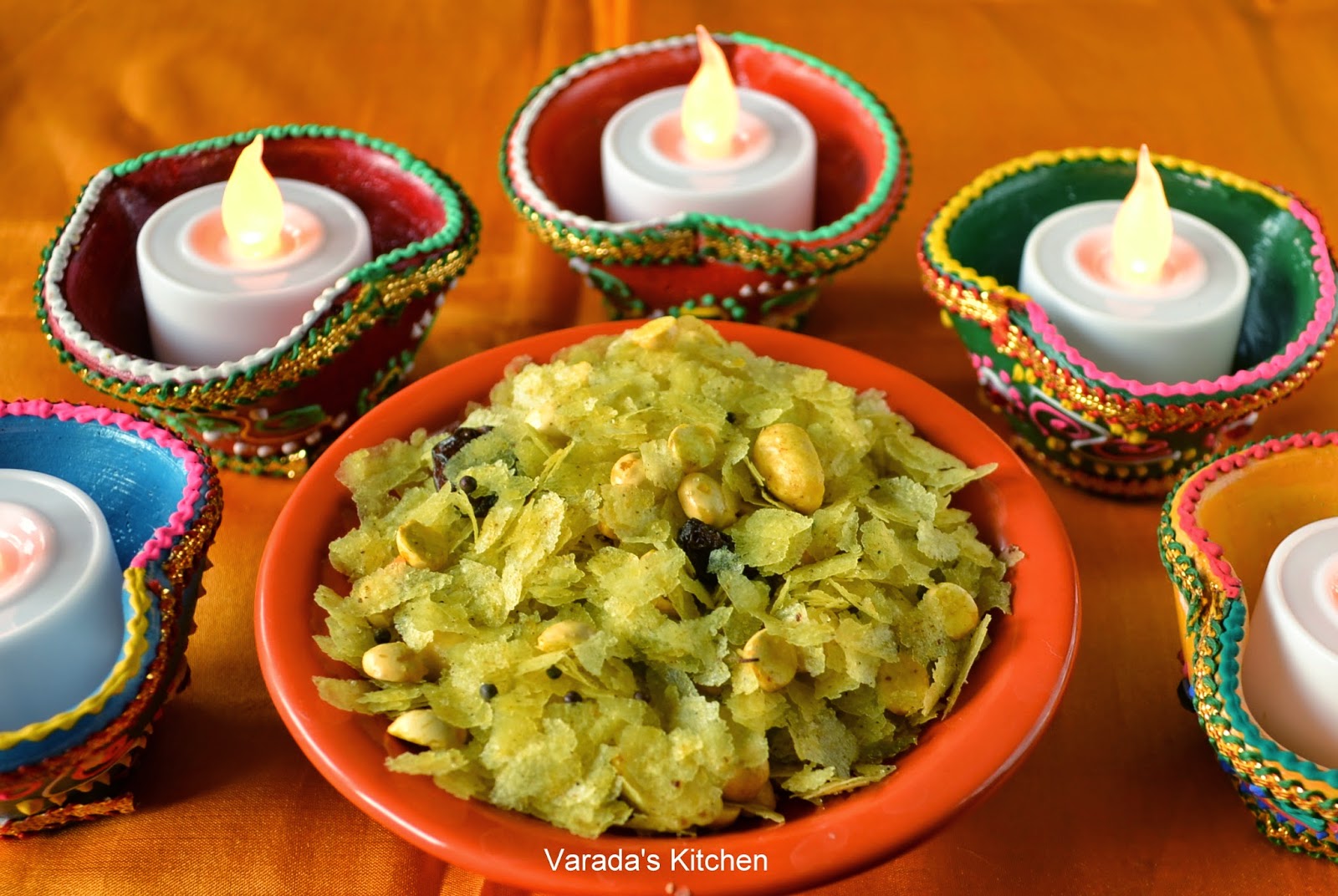
Bhajke Pohe Chivda (Flattened Rice Chivda / Poha Chivda)

Chivda made with pohe or flattened rice is one of the favorite savory faral dishes on the Maharashtrian Diwali platter. This chiva is similar to churmure chivda, which is made with puffed rice.


I like to use thin pohe for this chivda. The pohe are spread on a flat tray or baking sheet and put out in the sun for a couple hours. Unfortunately, it was a rainy gloomy day when I made this chivda so I used the alternative. I preheated the oven to 200 F and put the baking sheet with the pohe in it for about an hour. During the last 10 minutes I started making the chivda. The pohe were warm and crisp when I needed them.


You will need
6 cups pohe
1/4 cup oil (I used olive oil)
1 tsp. mustard seeds
2 Serrano peppers, cut into 1/2 inch pieces along the length
7-8 curry leaves
juice of half a lime
1/2 tsp. turmeric powder
1/4 tsp. red chilli powder (I used paprika)
salt to taste
1 1/2 cups roasted unsalted peanuts
1 cup daala (roasted yellow gram)
a handful raisins
1 tsp. sugar

If it is a sunny day and you are able to keep the pohe in the sun then put the pohe on a sheet, cover with a cloth or plastic sheet and keep in the sun for a couple hours. If keeping the pohe in the sun is not an option then preheat oven to 200 F. Spread the pohe on a baking sheet and put it in the oven for an hour. After every 15 minutes shake the pohe and put them back in the oven. The pohe will not change color, they will become crispy.


Gather all the ingredients needed for the chivda.


During the last 10 minutes of roasting the pohe start making the chivda. Heat oil in a deep pan and add the mustard seeds, the curry leaves and pieces of chilli pepper.


When the mustard seeds crackle add the lime juice and stand back. The lime juice will cause the oil to splatter. Once it stops add the turmeric powder, red chilli powder and salt. Mix well.

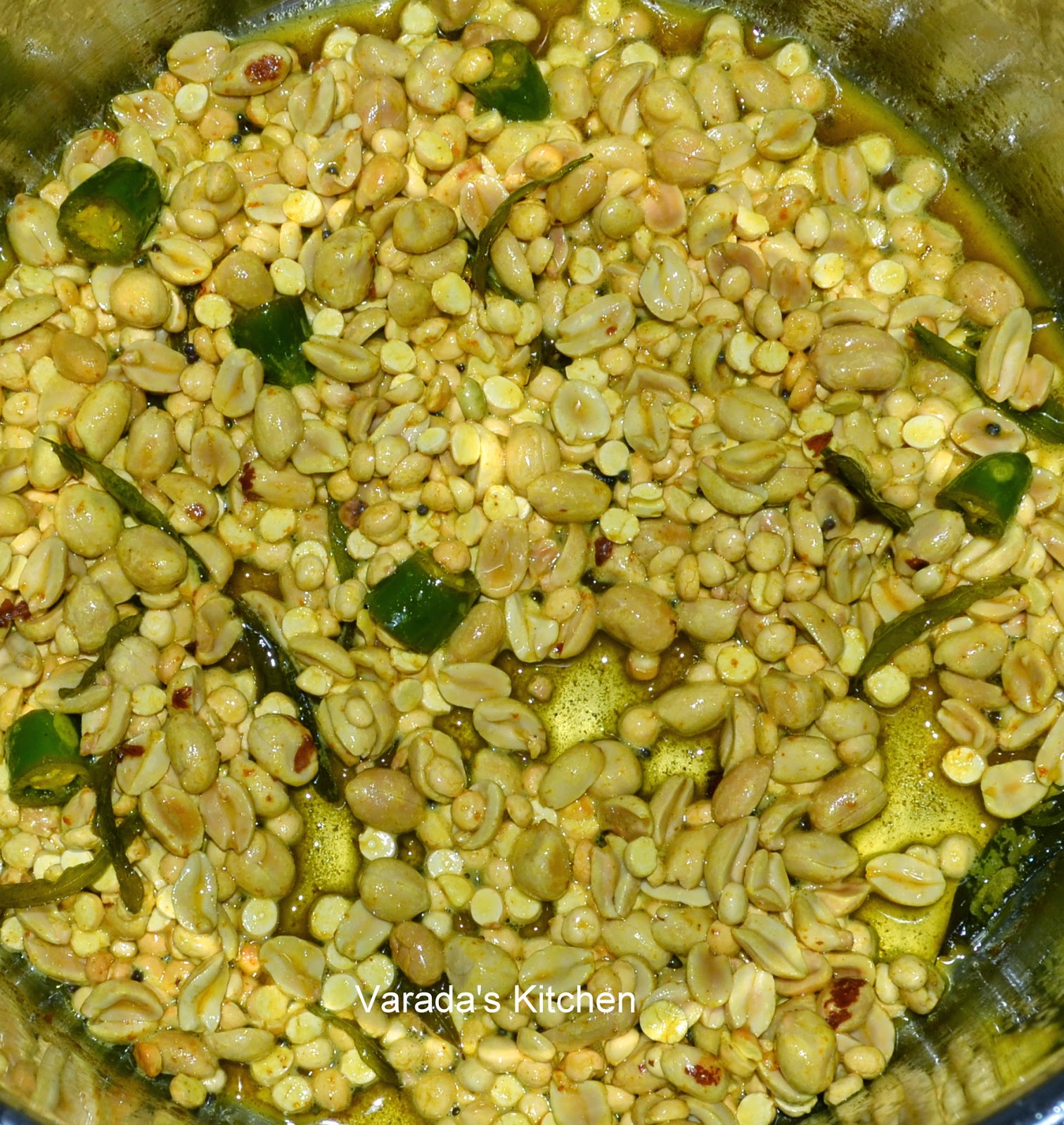
Now add the peanuts and saute them for a minute.


Add the daala (roasted yellow gram) and continue to saute for another minute.


Add the raisins and saute for a minute.


By this time the roasted pohe should be done. Add them to the pan along with the sugar. Turn off heat and working quickly mix everything together. Transfer to another container and allow to cool.


The chivda is ready!


Enjoy!

Note:
Turning off heat after adding the pohe and then transferring them to another container ensures that the chivda does not reek of oil.