Tuesday, April 29, 2014

Lesu (Mandua Roti / Finger Millet roti)

Today I am posting a recipe from Uttarkhand. Every day this month I will post a recipe from a different state in India.


The Kumaon and Garhwal regions of Uttar Pradesh are now their own state Uttarkhand. It is a beautiful region of the country located in the Himalayan foothills. Names of cities like Dehradun and Nainital bring visuals of natural scenic beauty and the faces of friends and neighbors from those regions.

A couple of my teachers in school were from this region. In high school we had danced to a very famous traditional Garhwali song 'Bedo pako barmasa'. There is a commercialized version of this song on youtube if you are interested. You can appreciate the beautiful melody of the song from the hills.

The food from Uttarkhand is similar to Uttar Pradesh and Himachal Pradesh. Wheat, Archar (toor), Mandua (Finger millet), Gahat (Kulath/horse gram) etc are commonly used grains and pulses. I have heard of Kulath dal made in Maharastra but have never tried it myself. I had never tried to use mandua either. I decided I had to use one of these (new to me) grains.


Lesu has a very interesting concept. It is not possible to roll mandua flour into a poli as we do with wheat. It may be the lack of gluten in the flour that requires it to be patted into shape. So the people from Kumaon came up with this solution. They made two different dough, one with wheat flour and the other with mandua flour. They stuff the mandua in the wheat and suddenly you have pliable dough that can be rolled into a poli.

This poli is best eaten hot. I got the recipe from here. This website has a lot of other interesting recipes that I would love to try out.

You will need
2 cups whole wheat flour
1/2 cup mandua (finger millet) flour
1/2 tsp. ajwain seeds
salt to taste

Mandua or Finger Millet is dark colored flour with darker specks.


Using water knead the whole wheat flour into a soft dough. Keep aside. In a separate bowl make dough with the ragi flour using water. Let it rest for 5 minutes.


Heat a griddle pan. Divide both dough into equal number of small portions. Take one portion of the wheat dough and flatten it on the palm of your hand.


Place a portion of the ragi flour in the flattened wheat dough.


Close the wheat dough over the top and form a ball.


Roll it out to a disc of the desired thickness. I like it thin so I rolled it to 1/4 of an inch.


Put a few drops of oil on the pan and place the rolled out poli on it. Put a few drops of oil on the top. Let it brown and then flip it over to cook the other side.


Take it off the heat when it is brown on both sides.


Serve hot.


Monday, April 28, 2014

Cheese Herb Monkey Bread or Pull Apart Bread

This month I suggested to the group Kneading Bakers that we bake savory or sweet pull apart bread. Pull apart or monkey bread is made with individual size biscuits. These biscuits are shaped separately, placed next to each other in a bowl or a loaf pan and baked.


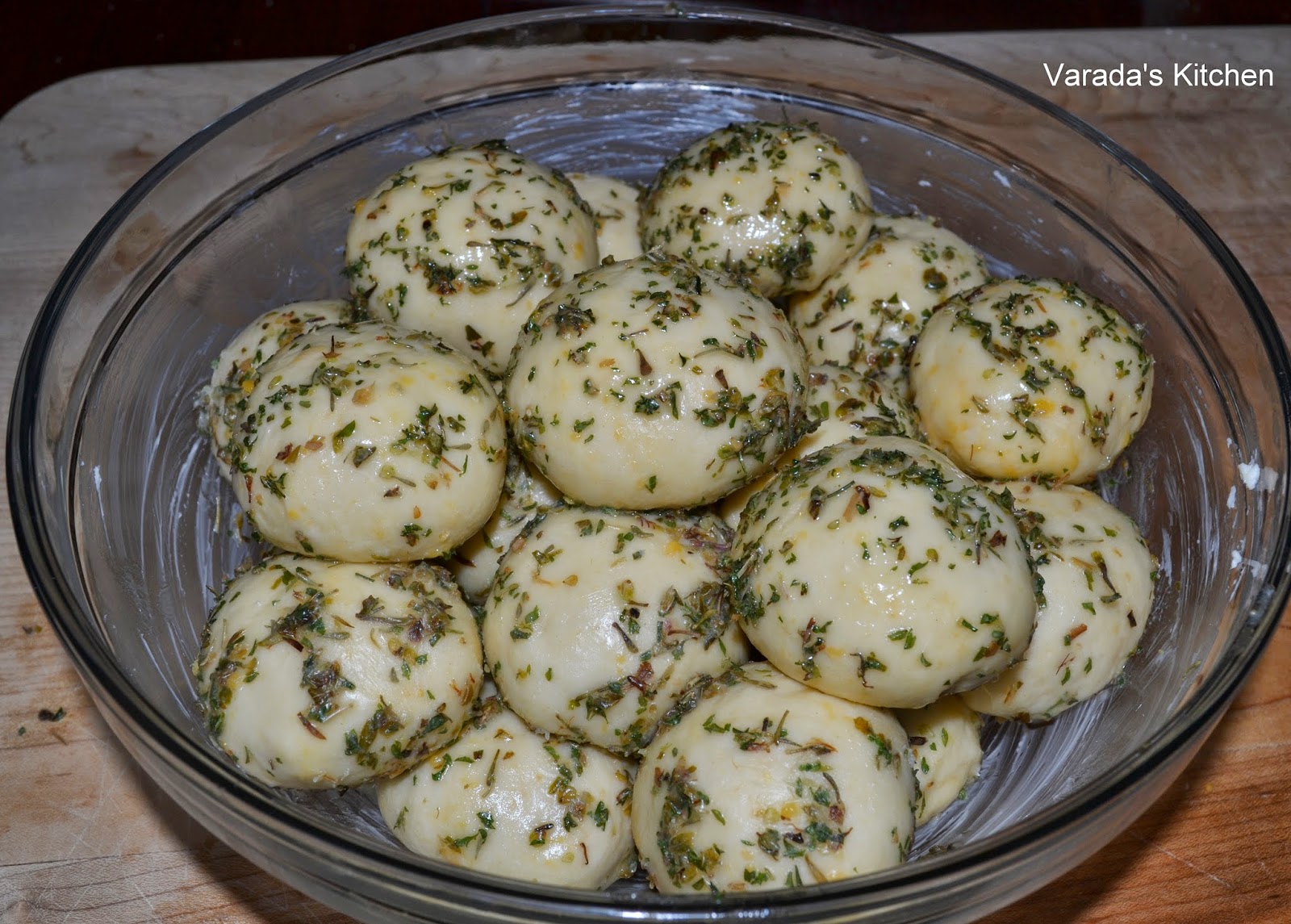
I thought the cheese and herb biscuits in a bowl looked adorable and wanted to try them. I used sharp cheddar cheese with dried parsley, oregano and thyme. The flavors went very well together.

You will need
For the dough
3 cups bread flour
1/4 oz. instant yeast
1 cup milk
1 tbsp. butter
1/2 tsp. salt
1 cup sharp cheddar cheese

For the dip
2-3 tbsp. butter
2 tbsp. parsley
2 tbsp. thyme
2 tbsp. oregano

To make the dough
Melt the butter. Warm the milk and beat it with the butter. Sift a cup of flour and yeast into the milk mixture. Let the sponge sit for 10 minutes.


In a separate bowl shred the cheddar cheese and mix it with the remaining flour.


Add it to the sponge and mix together to form a dough. Knead the dough for 10 minutes until smooth and elastic. Place in a well oiled bowl, cover and allow to rise for at least an hour until double in volume. Meanwhile grease a bowl with butter and keep aside.


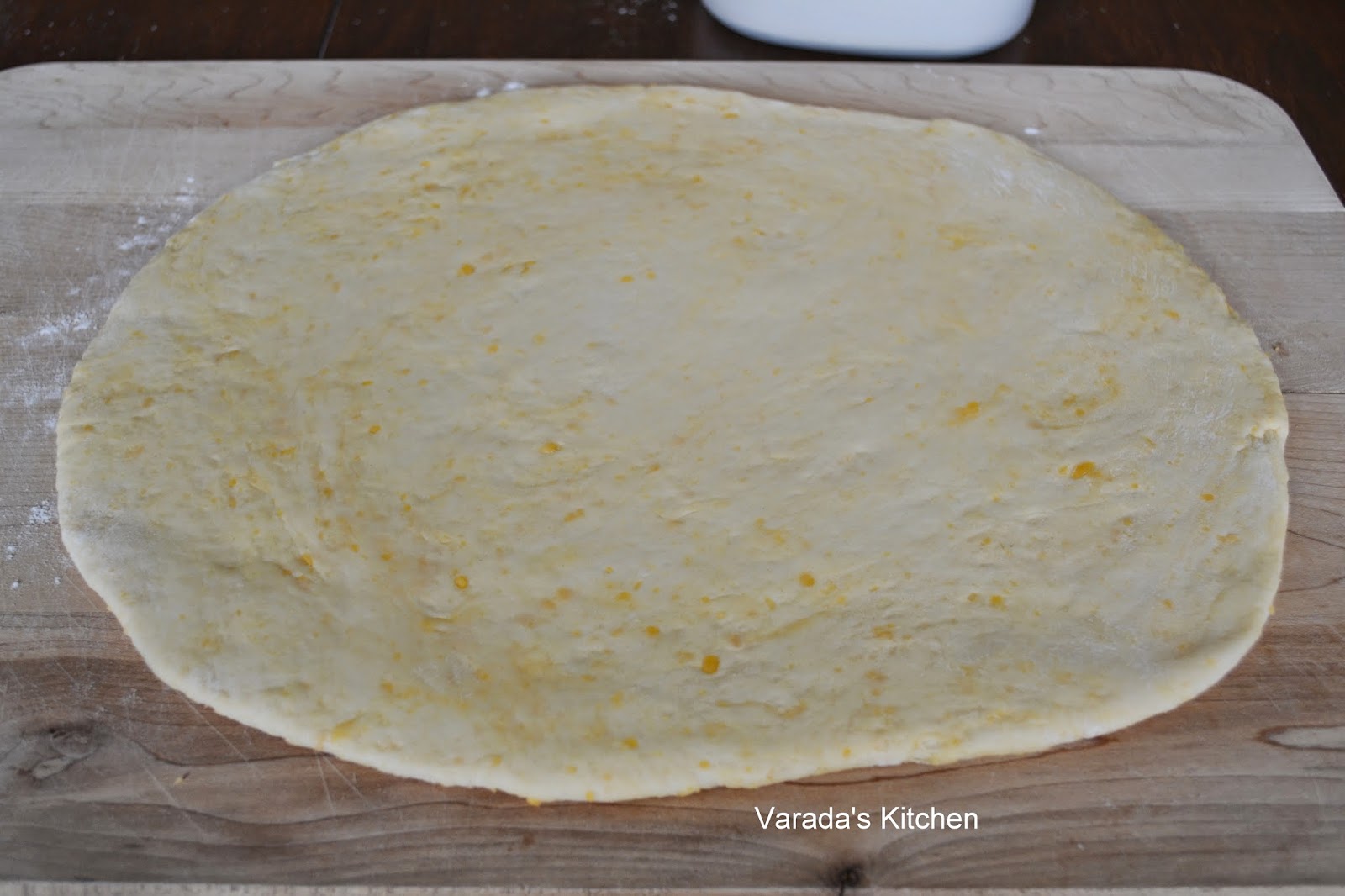
Transfer the risen dough on to a floured surface and roll it out in to a large rectangle. Using a sharp knife or pastry blender cut it into 2x2 inch squares.


Roll each square into a ball. Flour the working surface and using your palm roll the ball around on the surface to smooth it out. Repeat for each of the squares.


Melt the butter for the dip and mix in the parsley, thyme and oregano.


Pick up one of the balls of dough by the seam underside and roll it in the butter. Place it smooth side up in the greased bowl. Repeat for all the balls of dough. Cover and let it rise for about 30-40 minutes.


Towards the end of the rising period preheat the oven to 375 F. Bake the bread for 30-40 minutes. Check after 15 minutes and if the top is browning too fast tent it with aluminium foil. Continue to bake until the side and bottom are browned.


Serve hot.

Lauki ke Chilke ki Subji (Bottle Gourd Peel bhaji)

Today I am posting a recipe from Uttar Pradesh. Every day this month I will post a recipe from a different state in India.


Uttar Pradesh is located in northern India. It used to be the most populous state in the country. A few years back it was divided into two. The hilly region of kumaon and its surrounding areas was split to form Uttarkhand.

Last year at work I used to occasionally have lunch with a group of ladies of Indian origin. One of them was from Uttar Pradesh. One day she asked us to taste and guess the ingredients in a vegetable side she had brought. It tasted great but we could not identify the ingredient. Turns out it was the peel of  a bottle gourd. It was laced with besan.

Whenever I find fresh lauki with unblemished skin I reserve the peel and make this bhaji as a second side dish. The besan adds to the flavor. Today I used the peel of two lauki as I was trying to showcase the dish and wanted a substantial amount. The quantity is usually not enough to suffice as a side. You will need another bhaji if you are planning to serve this with poli.

Back to the recipe - my family now assumes this bhaji will accompany the lauki bhaji as I make it so often. No one complains as they love it too.

You will need
2 lauki
1 tsp. mustard seeds
1 tsp. cumin seeds
1 tsp. turmeric powder
1 tsp. coriander cumin powder
1/2 cup besan
salt to taste
2 tbs. olive oil

Peel the lauki and reserve the interior for another day.


Chop the peel into tiny pieces.


Heat oil in a pan and add the mustard and cumin seeds. When the mustard seeds crackle add the turmeric powder, coriander cumin powder and the peel pieces.


Cook them on medium heat for 5 minutes. Add salt and besan. Mix it well, cover and cook for a couple of minutes.


Uncover and mix well. Cover and cook till the besan is cooked through.


Serve hot.

Sunday, April 27, 2014

Savory Eatonian Kringle

I chose the Estonian Kringle bread because of how pretty it looked. The dough is rolled into a flat rectangle, filled with cinnamon sugar, rolled tightly into a roll, slit and shape.


On baking just before I was getting ready to make the filling my family revolted. They did not want another sweet bread. In the last few weeks I have made a few sweet breads like the beautiful bread, the Swedish coffee bread and the cinnamon swirl bread. So I gave in and switched to a savory version of this bread.


Instead of cinnamon bread I used goat cheese, basil pesto and sun dried tomato. My daughter does not like nuts in bread so I made the pesto with just basil and olive oil. I mixed all the filling ingredients together and used them just like the sweet version. The end result was pretty, very tasty and disappeared very quickly.

This recipe was adapted from here.

You will need
For the dough
2 tbsp. butter
1 tbsp. sugar
1 egg yolk
3/4 cup warm milk
2 1/4 cup bread flour
1/2 tsp. salt
1/4 oz. instant dry yeast

For the filling
3 tbsp. olive oil
4-5 leaves basil, chopped
2 tbsp. creamy goat cheese
a handful sun dried tomatoes (not soaked in oil), chopped

1 tbsp. milk

In a mixing bowl beat the melted butter and sugar. Add the egg yolk and beat. Add the milk and beat until combined. Sift in the flour, yeast and salt. Combine to form a soft dough. Knead for about 10 minutes until it forms a soft elastic dough.


Keep aside until it doubles in volume, about one hour.


In a blender blend the chopped basil with the olive oil. In a separate bowl combine the basil oil mixture with the goat cheese and sun dried tomatoes. Keep aside.


Preheat oven to 400 F. Transfer the risen dough to a floured working surface. Using a rolling pin roll it out in a large rectangle about a quarter of an inch thick,


Spread the filling all over the flattened dough leaving a half inch border all around.


Starting from one of the longer sides roll tightly into a roll.


Using a sharp knife cut the roll in half leaving it attached on one side.


Braid the two ropes ensuring the cut edge is facing outwards. Seal the edges together forming a wreath. Brush with milk.


Bake for 20-25 minutes. If the top browns tent with foil and continue to bake for another 15-20 minutes or a tester inserted in the middle comes out clean.


Serve hot.

Awan Bangwi (Steamed Rice dessert)

Today I am posting a recipe from Tripura. Every day this month I will post a recipe from a different state in India.


Tripura is one of the last states I cooked for. It is one of the Northeastern states of India. It was really difficult to pick a recipe for this state. At first I wanted to make something savory but we were all weary of experiments. So I decided to go with a dessert.


I picked Awan Bangwi as all the ingredients looked like they would go well together. And they did. I did not have the Laiu leaves called for in the recipe so I used banana leaf instead. During Ganesh Chaturthi we make patoli, a sweet very similar to this one. It is steamed in turmeric/haldi leaves. I wanted to use turmeric leaves for this recipe but could not find them. I made only a small amount as a trial.

I small milestone for me with this post, it is my 200th post.

You will need
1/4 cup rice (a local variety is used, but I used brown basmati)
4-5 Cashew
10-12 Raisins
1 tbsp. Butter or Ghee (I skipped this)
1 tiny piece of Ginger

Soak the rice overnight in water. Soak the raisins in water for an hour. Break up the cashew in small pieces. Grind the rice with very little water along with crushed ginger to form a thick paste. Add the cashews and raisins.


Wash the banana leaves. Form a cone with the leave and stuff with the paste. Seal shut with toothpick. Repeat for the remaining paste. I got two cones from the amount I had. Steam the stuffed cones in a pressure cooker for 10 minutes. When cooled unwrap.


Enjoy!

Saturday, April 26, 2014

Sundal (Black Channa with Coconut)

Today I am posting a recipe from Tamil Nadu. Every day this month I will post a recipe from a different state in India.


When I was in third grade we used to play in the playground very close to the school cafe that provided snacks and tea to teachers during the morning break. Sundal was on the menu two or three times a week. I loved the aroma of the dish. Sundal will always take me back to that playground.


Since then I have had sundal several times as prasad during the festival of navratri and it has always been a favorite. Everyone in my house loves sundal and so I decided to make it for the state of Tamil Nadu.


Today morning my daughter had to get to school really early. I asked my husband to get the soaked channa cooked in the pressure cooker while I dropped my daughter off so I could put it all together as soon as I got back. I hurried back and got everything else ready. Luckily, I checked the channa before adding it to the pot and found it had not cooked through. Sometimes the best made plans just don't work out.

This recipe is from a friend.

You will need
1 1/2 cups black channa
1/2 cup fresh desiccated coconut
3 dried red chili peppers
2 tbsp. mustard seeds
1/4 tsp. asafoetida

Soak the channa overnight and pressure cook the next day. They should be fully cooked and soft to the touch but not mushy.


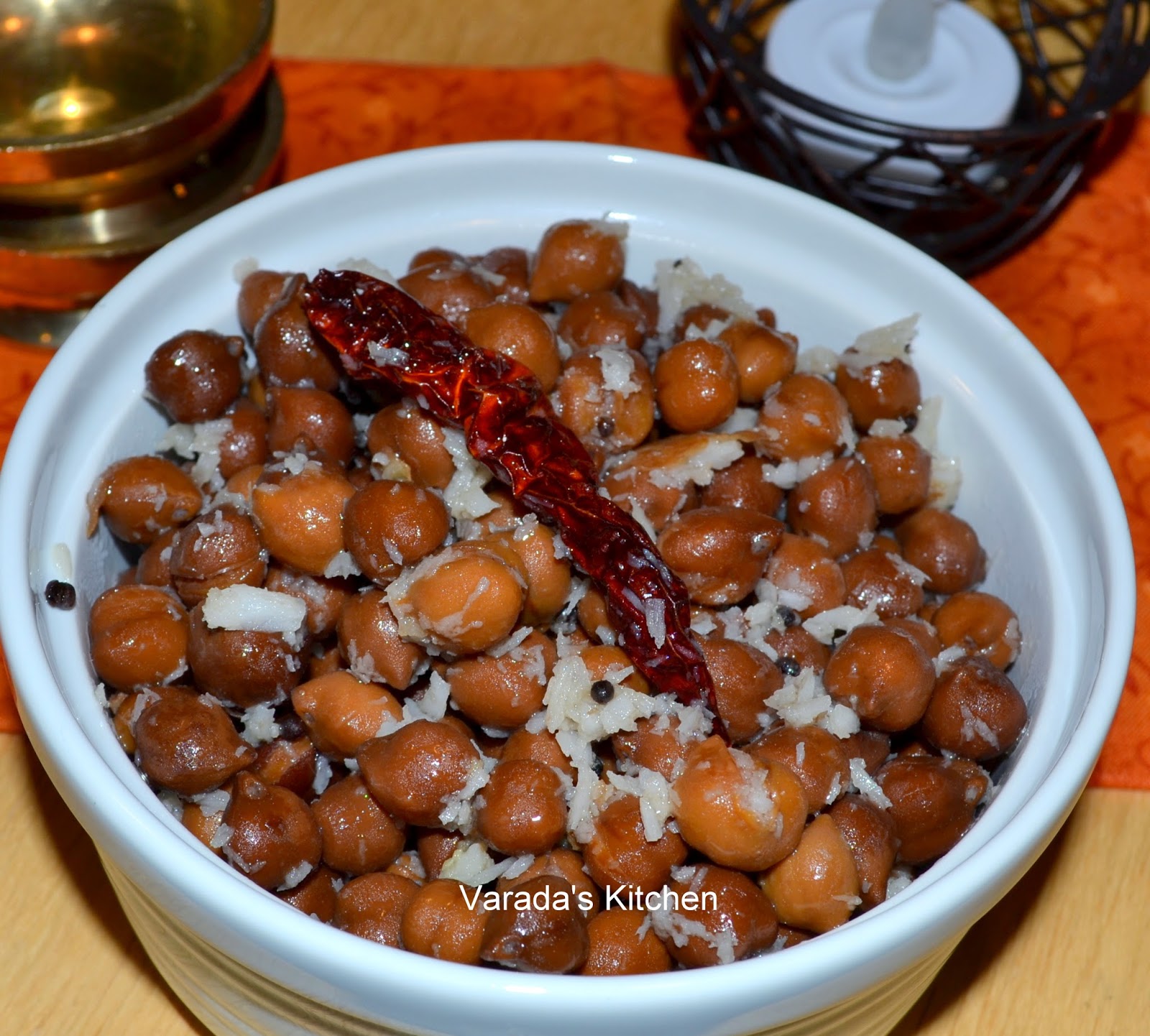
Heat oil in a pan and add the mustard seeds. When they crackle add the asafoetida, the red peppers, coconut and cooked channa.


Heat through completely and turn off heat.


Serve hot.

Friday, April 25, 2014

Kwati (Mixed Bean Stew)

Today I am posting a recipe from Sikkim. Every day this month I will post a recipe from a different state in India.


To be able to find authentic recipes from Sikkim is a challenge. It is even more so when you are living outside India. My quest took me to a very interesting Facebook page maintained by the Newar community from Gangtok.

Gangtok is the capital of Sikkim and on the Facebook page everyone talked about traditional authentic Newar recipes. I knew I had hit gold until I also noticed all the recipes were marked as Nepali. That is when I knew a little research into the history of Sikkim was needed.

Sikkim is located on the north eastern border of India. Until 1975 Sikkim was its own independent region with special status. It always had ties to India but only in 1975 did it join the Indian Union as the 22nd state. It is the only state with an ethic Nepali minority.

That explained the authentic traditional Nepali recipes from Gangtok. If you want a parallel this is similar to the southwestern US where Spanish speaking people in the states of Arizona and New Mexico became US citizens after those territories were acquired.

Now that I had all the pieces to the puzzle I knew I had the recipe for a dish from Sikkim. This recipe reminded me a lot of spicy bean soup. Here is the link to the original recipe. I used 7 different types of beans. Have fun collecting a combination of beans you like.


You will need
2 cups dry beans (a combination of Kidney beans, Garbanzo (chickpeas), black eyed peas, white navy beans, mung, black beans, soy beans)
1 onion
1 tbsp. ginger garlic paste
1 tsp. mustard seeds
1 tsp. cumin seeds
1 tsp. fennel seeds
1 tsp. carom seeds
4 tomatoes
1 tbsp. coriander cumin powder
1 tsp. paprika
1 tsp. turmeric powder
salt to taste

Soak overnight a total of 2 cups of dry beans. Pressure cook the beans until well cooked but not mushy.


Separate and reserve the water used to cook the beans.


Dice the onions. With a couple of tablespoons of water saute the onions until tender. Turn off heat. Run the cooked onions along with the ginger garlic paste through a blender.

Heat a large pan and when hot add the mustard, cumin, fennel and carom seeds. When the mustard seeds start to crackle, turn down the heat and add add the onion paste. Cook together for a couple minutes.


Meanwhile dice the tomatoes. Add tomatoes, coriander cumin powder, paprika and turmeric powder to the pan. Mix well and let it cook until the tomatoes are tender.


Add the cooked beans and mix everything together. Add as much of the reserved water as needed to make the gravy.


Bring it to a boil then lower the heat and let it simmer for another 5-10 minutes. Turn off the heat.


Serve hot with rice or poli.


A spicy bean stew that hits the spot on a cold day.